Sinclair Executive
Casing Type 1
Casing Type 2
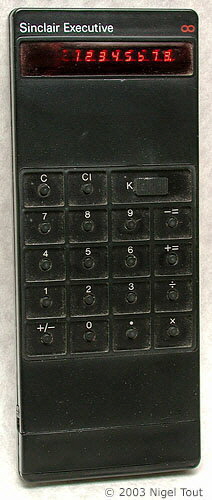
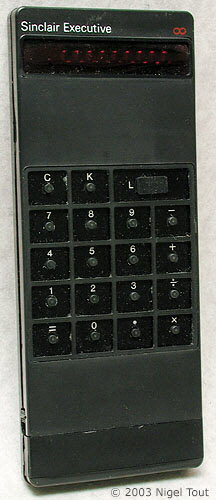
Sinclair Executive
There are two casing versions of the Sinclair Executive, with different keyboard markings.
Display is 8 digits, red LED.
4-function.
4x mercury button cells (some versions may use 3x mercury button cells).
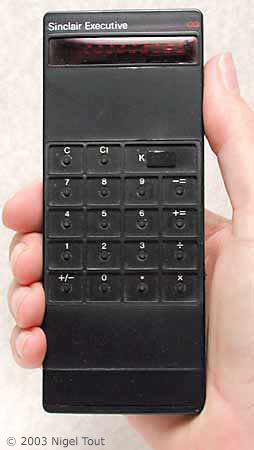
56 mm x 138 mm x 9 mm (2.2" x 5.5" x 0.4").
Introduced August 1972.
Made in England
The incredibly small thickness (see Executive Memory) for this stage in calculator development was attained by using button cells as the power source.
To achieve the low power consumption needed to employ button cells, with their
low capacity, the electronics of early versions was pulsed - not recommended by the manufacturer, but it worked.
The keypad uses a very thin plastic membrane moulding to keep the thickness down. The actual keys are the tiny
buttons in the centre of each pad area.
There is much more information In the Featured Hand-held Calculator section about the Sinclair Executive.

Showing how thin the Sinclair Executive models are.
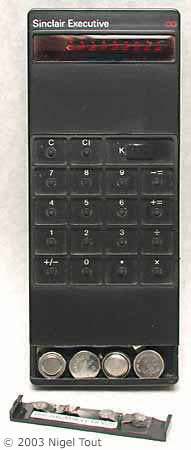
With battery cover removed, showing the four button cells.
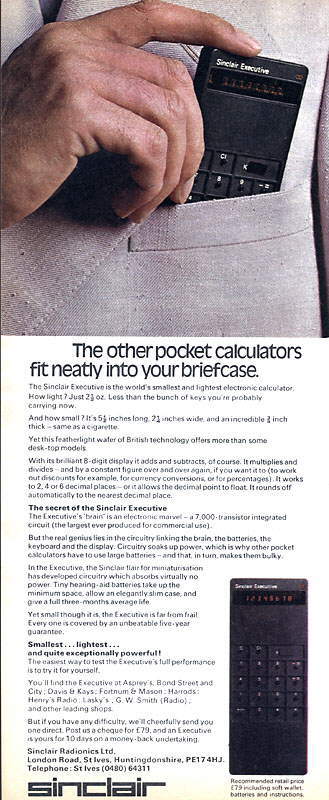
An advertisement for the Sinclair Executive, emphasising how slim it is.
It also explains "The secret of the Sinclair Executive: The Executive's "brain" is an electronic marvel – a 7,000-transistor integrated circuit (the largest ever produced for commercial use)"
For this period in the development of electronic calculators the Sinclair Executive was incredibly thin, attained by using button cells as the power source.
This was the first Sinclair calculator. It was one of the smallest calculators of the time and certainly the thinnest.
Clive Sinclair was already well known for his compact and innovative electronics. This demonstrated his flair with an incredible calculator design for this time.
Sinclair models
Vintage Calculators
© Text & photographs copyright Nigel Tout 2000-2019 except where noted otherwise.