Original Odhner
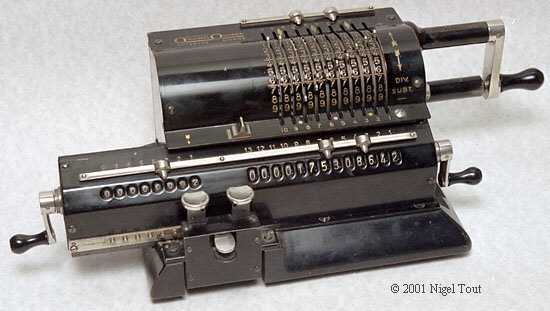
Original Odhner
Distinctive features: A Pin-wheel calculator.
The pin-wheel mechanism was the first commercially successful mechanical calculator mechanism that was designed for multiplication
and division, as well as addition and subtraction.
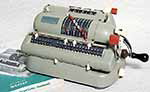
The model pictured:
10-digit setting register, 13-digit accumulator register, 8-digit revolutions register.
Made in Sweden in the period 1935-1945.
345 x 140 x 115 mm (13.6" x 5.5" x 4.5"), 5 Kg (11 lbs.).
Basic method of operation - When one of the setting levers is moved to a number then that number of pins is raised on the corresponding pin-wheel (ie. moving a lever to '7' raises 7 pins).
Turning the crank handle rotates all the pin-wheels, and their attached setting levers. The raised pins act as gear teeth and advance the individual accumulator wheels (with numbers at bottom right) by the number of pins, so adding the set number to the accumulator.
Multiplication is fairly straight forward since the handle can be turned several time quickly to add the same number to the accumulator. The numbered wheels at bottom left keep a record of the turning of the handles.
Moving to
the next decade involves pressing the appropriate lever at the front.
The small cranks on each side at the front are for clearing the device.
This type of calculator, the pin-wheel calculator, was invented by the Swdish engineer and entrepreneur Willgodt T. Odhner in St. Peterburg, Russia, in 1874. (A calculator on similar principles had been invented independently 2 years earlier by Frank Baldwin in the USA, but the Odhner was the successful design). Following the Russian Revolution of 1917 and the nationalisation of the factory there, production moved to Sweden and the name "Original Odhner" was adopted.
This was the most successful type of general purpose mechanical calculator (ie. intrinsically capable of multiplication and division and not just "adding machines"). Up to the early 1970s dozens of manufacturers made machines based on and with a general resemblance to the Odhner, as shown at the bottom of this page.
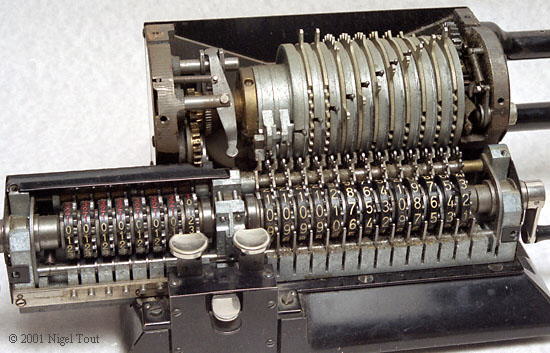
With front covers removed, showing the pinwheels, at the top, the accumulator register below, and the revolutions register on the left.
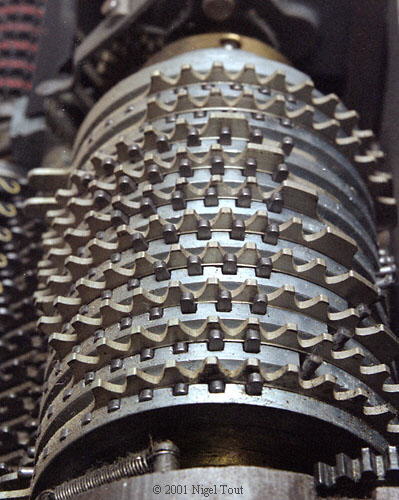
Close up of the pin wheels, looking from the right, with the number of pins raised on each wheel depending on the number set by each lever (from top to bottom 0087654321).
These act as gear teeth
when the crank handle is turned.
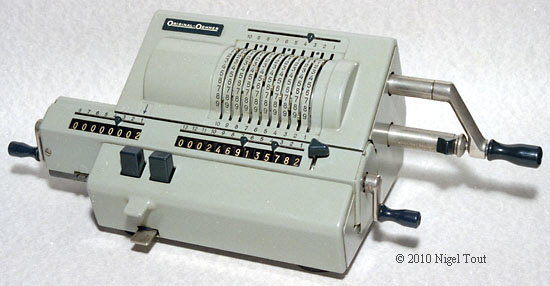
A later model of Odhner pin-wheel calculator, from the 1950s-1960s, has the same layout as the older model shown at the top of this page but with a more modern design.
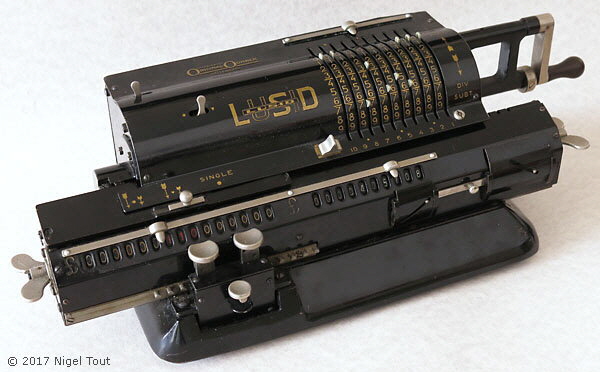
Odhner LUSID calculator for use with the old British Sterling £sd currency. This is a featured calculator in the Non-decimal Calculators section of this site.
 |
|
|
|
Kevin Odhner (yes, related to the inventor) has an excellent site with a fascinating history of Odhner mechanical calculators at http://odhner.com/kevin/wtodhner/.
Timo Leipälä has researched and has produced an important document "The life and works of W. T. Odhner", which is available in two parts: part 1 and part 2.
The YouTube video "The Original Odhner (Vintage Calculator)", which includes finding a square root, is at https://www.youtube.com/watch?v=Bz8_tNDUDog
For further information on performing the basic arithmetic operations see Operating a Pinwheel Calculator in the "Collecting Calculators" section of this site.
To see John Wolff strip down an Odhner calculator to reveal its nearly 700 parts, and put it back together, go to http://www.johnwolff.id.au/calculators/Tech/OdhnerPinwheel/Odhner239Rebuild.htm.
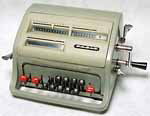
The Odhner machine shown above has the classic arrangement of the pin-wheel calculator. A variation is shown on the later Facit models which use keys for setting, for increased speed: |
||
|
|
||
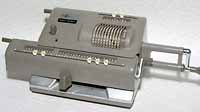
Some further pin-wheel calculators which appear on this site are shown below:
Mechanical Calculators
Vintage Calculators
Text & photographs copyright, except where stated otherwise, © Nigel Tout 2000-2026.