Home > Hand-held Calculators
Featured Electronic Hand-held Calculators:
A study of the Featured Desktop Electronic Calculators section shows that through the 1960s large numbers of electronics components were required in a calculator. So electronic calculators were then very large, consumed a lot of power, and only AC-powered desktop models were available.
As integrated circuits were developed it was possible to squeeze more and more functionality into fewer and fewer chips. So electronic calculators became smaller and also their power consumption was reduced. The fascinating story of the development of miniature electronics for calculators and the competing companies involved is told in the section "The Race to Make a Pocket Calculator" on this site.
By 1969 several companies had produced AC-powered calculators employing just a handful of integrated circuits which had a low power requirement, such as Sharp of Japan with the QT8-D desktop calculator. Then by replacing the AC power section with rechargeable batteries the first hand-held calculators were produced. Thus Sharp produced the QT8-B, which was advertised in the U.S.A. in mid-1970, and around the same time Sanyo brought out the ICC-0081 (in the Portable Electronic Calculator Section) and ICC-82D, with Canon introducing the Pocketronic. All of these models, which are featured here, can be used hand-held and remote from AC power, but are much too large to be called pocket calculators.
However, technology was developing very rapidly and there followed in late 1970/early 1971 much more pocketable models from Canon, Sanyo, and Sharp, and the first truly pocket calculator, the Busicom LE-120A. The world was astounded when the first pocket electronic calculators became available in the shops and enabled anyone who could afford one to carry a means to instant answers to their mathematical needs.
Initially the high cost of the leading edge electronics used in the early hand-held calculators meant that the price of these calculators was also very high. Many companies saw the possibility of making a profit and started to produce electronic hand-held calculators. So, over the next few years several thousand models were produced by two to three hundred companies. Some of these companies are obscure and produced only one or two models (see the "One Hit Wonders" page), whereas a handful of companies survived the plunge in calculator prices of the mid-1970s and continue to produce calculators today.
The alternative to the early, expensive, hand-held electronic calculators was the slide rule, including the Otis-King cylindrical type, and the miniature mechanical calculator such as the Curta, see the bottom of this page. These devices continued to sell into the mid-1970s when the cost of hand-held electronic calculators fell so that they became affordable by all.
The early designs of hand-held calculators were very varied, and some now appear to be quite exotic. Frequently models were named "Electronic Slide Rules", illustrating that the device was seen as a replacement for the mechanical slide-rule.
Featured here are significant hand-held calculators and a selection of typical models.
There are also photographs of many other hand-held electronic calculators in the Hand-held Calculator Photo Library on this site.
For information about the electronics inside the calculators see the Calculator Technology section.
Click on a picture below for more details and more, bigger pictures.
The first prototype hand-held calculator
Texas Instruments "Cal-Tech"prototype
1967
Four-function. Output printed on paper tape.
Prototype first hand-held calculator, was not produced commercially by Texas Instruments, but was developed into the Canon Pocketronic.
The first battery-powered, hand-held calculators
These first hand-held, battery-powered, models which were developed by Sharp, Sanyo, and Canon were all launched in Japan in 1970. The exact sequence that they went on sale is difficult to establish, but the order here is believed to be correct. Note that they are all bulky and by no means can be considered "pocket calculators" as we now know them.
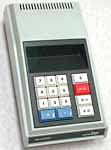
Sharp QT-8B "micro Compet"
1970
Four-function.
Has rechargeable cells and green vacuum fluorescent display (VFD) tubes.
Uses a four-chip chipset manufactured by Rockwell.
One of the first hand-held calculators.
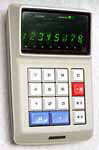
Sharp EL-8 (aka Compet ELSI-8), Facit 1111, & Addo-X 9364
1970
Four-function.
Has rechargeable cells and green vacuum fluorescent display (VFD) tubes.
Uses a four-chip chipset manufactured by Rockwell.
One of the
first hand-held calculators.
Calculators using the same electronics badged for other companies.
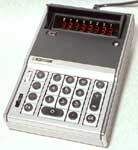
Sanyo ICC-82D
1970
Four-function.
Has
rechargeable cells and amber gas-discharge tubes.
Uses a four-chip chipset manufactured by Sanyo.
One of the first hand-held calculators.
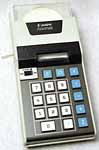
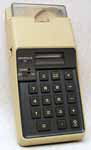
Canon Pocketronic, Pocketronic II, & Monroe 10
1970
Four-function.
Output printed on paper tape, has rechargeable cells.
First models used a three-chip chipset manufactured by Texas Instruments.
Some of the first hand-held calculators.
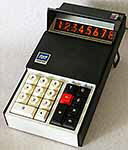
SCM Marchant I
1970
Four-function.
Has rechargeable cells and "Nixie"-type display tubes.
Uses either a
two-chip chipset manufactured by American Micro-systems Inc. (AMI) or a three-chip chipset manufactured by Texas Instruments.
One of the first hand-held calculators
.

The first truly pocket-size electronic calculators
... able to fit in a shirt pocket.
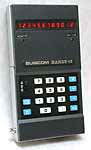
Busicom LE-120A HANDY LE
1971
Four-function.
Has LED display and uses disposable batteries.
Uses "calculator-on-a-chip" manufactured by Mostek.
The Busicom LE-120A was the first calculator small enough to be truly described as "pocket-sized", the first calculator using an LED display (12-digits), and the first hand-held calculator using a "calculator on a chip" integrated circuit (made by Mostek).
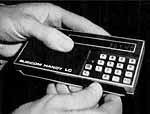
Busicom HANDY LC
1971
Four-function.
The Busicom HANDY LC was a Liquid Crystal Display (LCD) version of the LE-120A HANDY LE calculator above. It was never sold commercially.
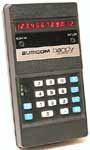
Busicom LE-120S handy
1971
Four-function.
Uses "calculator-on-a-chip" manufactured by Mostek.
The Busicom LE-120S was a slightly later and
cheaper version of the LE-120A.
Featured hand-held electronic calculators, in approximate chronological order
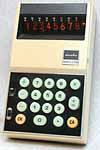
Minolta Minolcom
1971
Four-function,
'Nixie'-type tubes.
Uses a four-chip chipset manufactured by Sanyo.
Early hand-held calculator badged for sale by the Minolta camera company
.
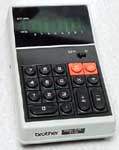
Brother PRO-CAL 408
1971
Four-function,
vacuum fluorescent display tubes.
Early hand-held calculator from Brother.
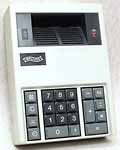
Walther ETR3
~1971
Four-function, "Nixie"-type
display tubes.
Uses a six-chip chipset manufactured by Electronic Arrays.
Early hand-held calculator from Walther, an established manufacturer of mechanical calculators.
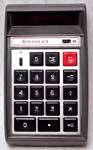
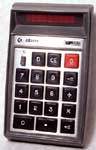
Bowmar 901B, also sold as the Commodore (cbm) C110 and the Craig 4501
1971
Four-function.
The first calculator from Bowmar, for a time the largest calculator manufacturer in the U.S.A. Red LED display.
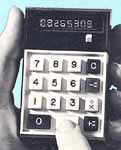
Ragen Microelectronic Calculator
1971/2
Four-function.
Was to be the first sub-$100 calculator, the first Liquid Crystal Display calculator, and the first calculator using CMOS semiconductors: widely announced but never went
on sale.
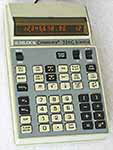
Compucorp 320 'Scientist' Series
1971
A series of high-functionality Scientific calculators, including programmable models.
Used multi-chip chipsets, mainly manufactured by Texas Instruments.
The first portable scientific calculator.
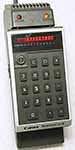
Canon Palmtronic LE-10
1971
Four-function.
Batteries recharged by plugging into base unit, red LED display.
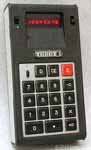
Texet 1
1972
Four-function.
Uses the first Texas Instruments 'calculator-on-a-chip'
, red LED.
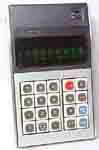
Sharp EL-811, Prinztronic MC85, Prinztronic MC95
1972
Four-function, memory.
The second hand-held calculator from Sharp, and versions re-badged for a chain store, vacuum fluorescent display tubes.
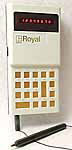
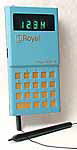
Royal Digital III and Digital IV
1972
Four-function.
Use electrical stylus instead of keys.
Digital III has a 4-digit (!!!) vacuum fluorescent tube display
.
Digital IV has an 8-digit red LED display.
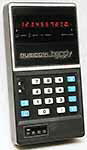
Busicom LE-100A "handy" & NCR 1844
~1972
Four-function.
The Busicom LE-100A is a development of the LE-120A, using a Texas Instruments "calculator on a chip" and 10-digit LED display.
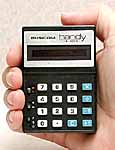
Busicom LE-80A "handy"
~1972
Four-function.
The Busicom LE-80A is an incredibly tiny calculator for this time. It is a development of the LE-120A, using a Texas Instruments "calculator on a chip" and
8-digit LED display.
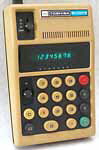
Toshiba BC-0801B
1972
Four-function.
The first Toshiba hand-held electronic calculator, blue VFD display.
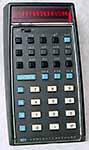
Hewlett Packard HP-35
1972
Scientific.
The first pocket-sized scientific calculator, red LED display.
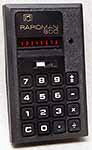
Rapid Data Rapidman 800
1972
Four-function.
One of the first sub-US$100 / sub-£40 GBP electronic calculators, red LED display.
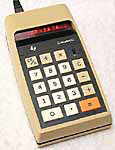
Texas Instruments 2500 "Datamath" & similar models
1972
Four-function.
The first of the long line of calculators from Texas Instruments, red LED display.
The first successful hand-held calculator with liquid crystal display (LCD)
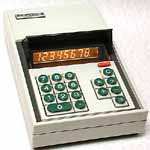
Lloyd's Accumatic 100
1972
Four-function.
The first successful hand-held calculator with Liquid Crystal Display. LCD has reflective numbers.
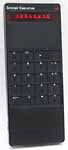
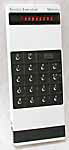
Sinclair Executive
1972
Four-function.
Very thin, the first calculator to be powered by button cells, red LED display - the first Sinclair calculator.
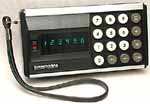
Casio Mini
1972
Four-function.
One of the first sub-US$100 / sub-£40 GBP electronic calculators, vacuum fluorescent display tubes.
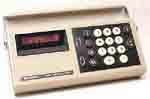
Sanyo ICC-809
~1972
'Portable radio'-shaped case
.
Orange gas-discharge display.
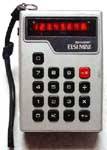
Sharp EL-801
1972
Four-function.
First calculator using CMOS integrated circuits, red LED display.
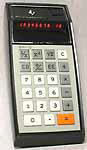
Texas Instruments SR-10
1972
Semi-scientific.
Texas Instrument's first electronic 'Slide Rule'.
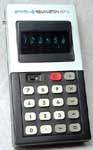
Sperry Remington 661-D & 661
1972/3
Four-function.
6-digit display, vacuum fluorescent display tubes.
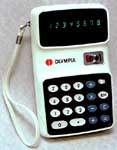
Olympia CD 81 / Panasonic JE-855U
1972/3
Four-function, memory.
One of the most stylish & highest quality calculators, vacuum fluorescent display tubes.
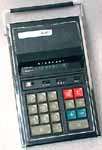
apf Mark V
1972/3
Four-function.
Has battery voltage meter.
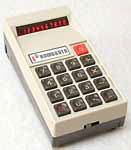
Ramsgate M-11
c1972
Four-function, 10-digit LED
display.
From one of the many small companies which manufactured calculators for a year or two.
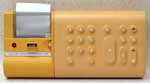
Olivetti Divisumma 18
1972
Four-function.
An Italian iconic design. Prints output on thermal paper.
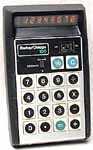
Atlas-Rand 240
Berkey Keystone 370
Berkey/Omega 100
Keystone 88
1972
Four-function, %.
A series of similar models with Panaplex gas-discharge displays.
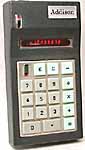
Iain Jones International Addison Mini A
1972/3
Four-function.
Has battery-level meter. From one of the many small companies which manufactured calculators for a year or two.
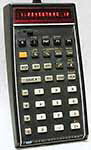
Hewlett-Packard HP-80
1973
Business and
financial functions.
The first hand-held business calculator.
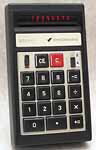
Litronix Checkmate
1973
Four-function.
One of the first calculator models from Litronix, a major manufacturer of LED displays.
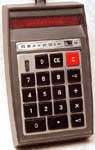
Heathkit IC-2009
1973
Four-function.
Make it yourself calculator kit, red LED display.
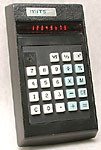
MITS 150
1973
Four-function, square root.
Make it yourself calculator kit or bought ready assembled
, red LED display.
Also photographs of other MITS calculators.
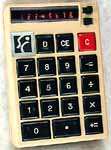
Summit Ko9V
~1973
Four-function, constant, red LED display.
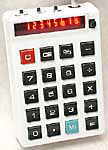
Summit SE88M
~1973
Four-function, %, memory, with reciprocal, square, & square root buttons on top, red LED display.
Extremely small calculators for the time, but chunky.
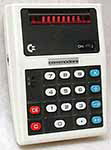
Commodore MM3 and related models
1973
Four-function calculator and related models with more functions, red LED display.
A series of small chunky calculators of similar design.
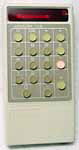
Unicom 102
1973
Four-function.
Company bought by Rockwell before the development of its own extensive range of calculators, red LED display.
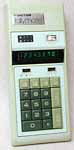
Victor 85 "Tallymate"
1973
Four-function,
with battery-level meter.
From the Victor Comptometer Corporation.
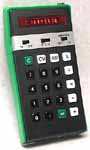
Elka 101
1973
Four-function, memory.
Bulgarian (then a communist state) manufactured calculator using Rockwell integrated circuit.
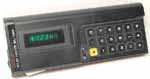
Sharp EL-120
1973
Four-function, also has a counter button.
3-digit display.
The first Successful pocket-sized calculator with liquid crystal display (LCD) and using COS technology
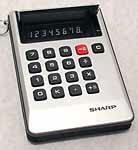
Sharp EL-805 & other early LCD calculators from Sharp
1973
Four-function.
The first pocket-sized LCD (Liquid Crystal Display) calculator.
Uses Sharp's COS (Crystal On Substrate) technology.
Includes details of other early
Sharp LCD calculators.
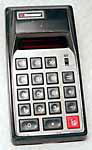
Bowmar MX-55 & Hiradastatechnika version
1973
Four-function, %.
A common U.S. calculator and a version made in Hungary.
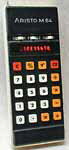
Aristo M64
1973
Four-function, %, square root.
One of a series of smartly styled calculators made in Germany by Aristo, the famous manufacturer of slide-rules.
Want an electronic calculator but not sure if you can do without a slide-rule?
Then how about a slide rule
combined with an electronic calculator ?
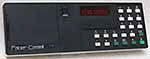
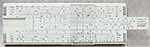
Faber-Castell TR1
1974
Four-function, %,
square root.
Combined electronic calculator and slide-rule made in Germany by the famous manufacturer of slide-rules.
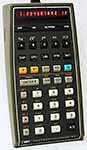
Hewlett-Packard HP-65
1974
The first hand-held
programmable calculator.
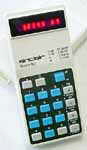
Sinclair Scientific
1974
Small and low-cost scientific
calculator.
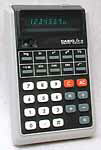
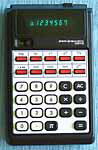
Casio fx-10 & Sperry Remington SSR-8
1974
The first Casio hand-held scientific calculator, and the same model made for Sperry-Remington.
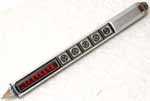
Calcu-pen
1975
Four-function.
A calculator squeezed into a (rather thick) ball-point pen.
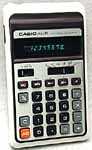
Casio AL-8 & family models (AL-8S, AL-10)
1975
The first hand-held calculators to accept and display fractions.
Some popular low-cost calculators
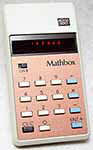
Novus 650 "Mathbox"
1974
Four-function.
A
minimalist calculator without a decimal-point key.
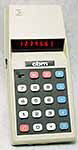
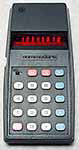
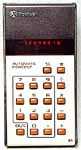
Rockwell 8R and varieties
1975
Four-function, %.
Popular low-cost calculator, and varieties produced for other companies.
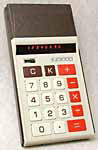
General Instrument EZ3000 and varieties
1975
Four-function.
Calculator produced by integrated circuit manufacturer. Designs sold to the U.S.S.R.
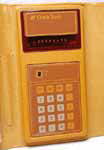
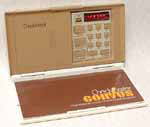
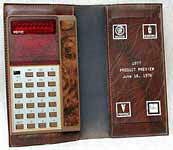
Check Tronic,
Corvus CheckMaster,
Novus Billfold 91
About
1975/6
Four-function and two-function, bank cheque (check) account balancing calculators and billfold (wallet) calculator.
The Check Tronic and CheckMaster store the balance even when switched off
.
The CheckMaster is probably the least capable hand-held electronic calculator ever marketed.
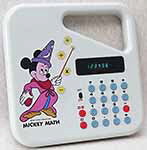
alco Mickey Math
1975
Four-function.
Calculator aimed at introducing young children to electronic calculators.
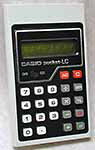
Casio pocket-LC
1975
Four-function, %,
memory.
The first calculator using the now standard TN (Twisted Nematic) LCD (Liquid Crystal Display) with black numbers.
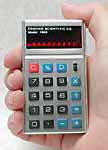
Monte Carlo and similar models
1975
Four-function, %.
A series of similar very tiny calculators which use a rechargeable battery pack which plugs directly into an AC outlet.
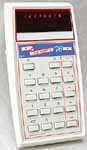
Texas Instruments Spirit of '76
1975
Four-function, %.
Special edition commemorating the bicentenary of the independence of the U.S.A.
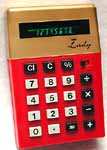
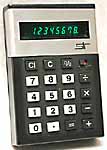
Two of the first electronic calculator watches
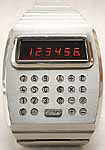
Pulsar
1975
The first LED calculator watch.
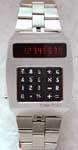
Compuchron
1976
LED calculator watch.
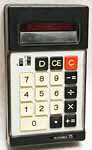
RFT minirex 75
1976
Four-function.
East Germany (then a communist state) manufactured calculator .
Docks into recharger unit.
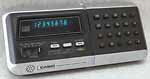
Casio CQ-1 "Computer Quartz"
1976
Calculator clock.
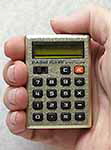
Casio micro-mini M800 & Casio micro-mini M810
1976
"Matchbox"
size.
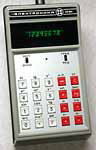
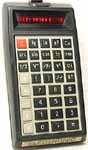
Elektronika B3-18 & Elektronika C3-15
1976-1977
Scientific functions.
The first Soviet-made scientific hand-held calculators
.
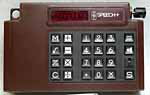
Telesensory Systems Speech+ & other Speaking Calculators
1976
The first hand-held speaking calculator, designed for the visually impaired, and one of the first consumer products with speech synthesis
.
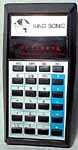
'Standard Type 1'
~1976
Popular low-cost calculators, sold under
many names.
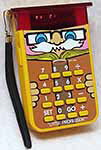
Texas Instruments Little Professor
1976
Calculator based mathematical learning aid & game.
The first electronic calculators equipped with solar cells (used for charging the batteries)
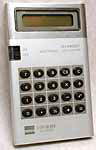
Sharp EL-8026 "Sun Man" & Royal Solar I / Triumph-Adler 1980
1976
Four-function, memory,
square root.
The first electronic calculators with solar cells, for recharging the batteries.
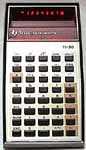
Texas Instruments TI30
1977
Popular low-cost but
capable calculator.
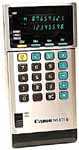
Canon Multi 8
~1977
Calculator with 2 lines of display
.
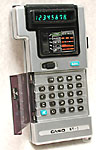
Casio ST1
~1977
Combined Stopwatch and Calculator.
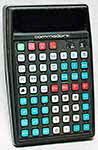
Commodore S61
1977
Statistical calculator with 61 keys.
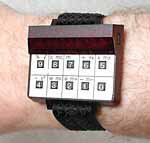
Casio "Micro Quartz" MQ-1 and MQ-2
1977
Tiny
calculators with clocks.
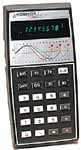
Kosmos I
1977
Four-function calculator and biorhythm computer
.
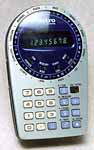
Kosmos Astro
Four-function calculator and astrological predictor.
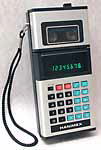
Hanimex Calculator-Recorder
~1977
Calculator
and Mini-Cassette Recorder combined.
You are a 'Soroban' (abacus) user and are thinking of getting an electronic calculator.
Then how about a
'Soroban' combined with an electronic calculator ?
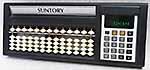
Suntory combined Soroban (abacus) & Electronic Calculator
~1977
Electronic
calculator combined with a soroban (Japaneses-style abacus).
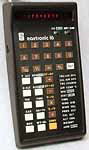
Specialized Electronics Corporation Navtronic 16
~1976
Navigation functions.
Specialist navigation calculator using dedicated electronics.
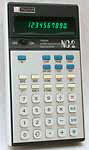
Tamaya NC-2
~1976
Scientific and
astro navigation functions.
Specialist navigation calculator using dedicated electronics.
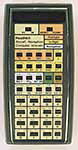
Heathkit OC-1401 & OCW-1401
~1978
'Aircraft Navigation Computer' and scientific functions.
Specialist navigation calculator using dedicated electronics.
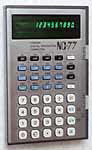
Tamaya NC-77
1978 - 1991
Scientific and astro navigation functions.
Specialist navigation calculator using dedicated electronics. Had an unusually long production run.
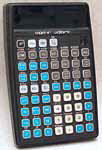
Commodore N-60
~1978
Navigation
functions.
Specialist navigation calculator using dedicated electronics.
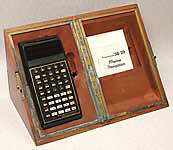
Texas Instruments Navigatronic
~1978
Scientific and navigation functions.
General-purpose calculator fitted with Navigation library module.
See also the article on this site 'Goudime Astronavigation Calculator - A Prototype Navigation Calculator from 1975 based on the the Intel 8080 Microprocessor'.
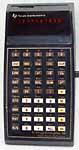
Texas Instruments TI 58
1977
Scientific programmable.
Replaceable program memory module allows calculator to be customised, see above.
Three special-function calculators
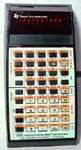
Texas Instruments USMC Harrier VSTOL/REST Calculator
~1978
Functions
for use with flying the McDonell-Douglas AV-8A "Harrier" vertical/short take-off and land aircraft flown by the United States Marine Corp.
Texas Instruments TI-58 calculator with customised program module.
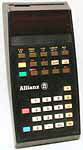
Texas Instruments Alianz insurance calculator
~1978
Functions for insurance calculations.
Texas Instruments TI-58 calculator with customised program module.
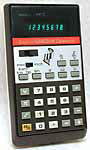
Sandvik Coromant 842S
~1978
Has specialist functions
for metal cutting calculations.
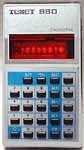
'Standard Type 2'
~1978
Popular low-cost calculators, sold under
many names.
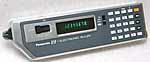
Panasonic JE-8210U "Electronic Ruler"
~1978
Calculator
and length measurement.
The first credit card sized electronic calculator
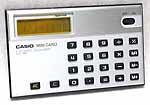
Casio Mini Card LC-78
1978
The first credit card sized calculator.
The first solar-powered electronic calculator
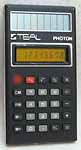
Teal Photon
1978
Appears to have been the first purely solar-powered calculator, and so one of the first electronic calculators without an on/off switch!
Feet and Inches calculators
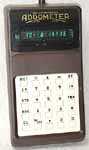
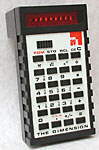
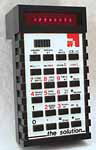
SCAT specialist calculators
~1980
A series of specialised calculators, including a
Feet & Inches calculator and a Chemical Solutions & Dilutions calculator.
Three solar-cell powered, almost credit-card sized calculators
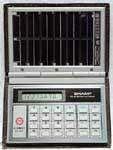
Sharp EL-825 & similar models
1980
Four-function, memory, square root.
An early solar-cell powered, credit-card sized LCD calculator.
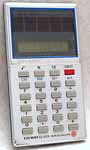
Sharp EL-826
1980
Four-function, memory, square
root.
An early solar-cell powered, almost credit-card sized LCD calculator. Solar-cell is high-efficiency, hence small.
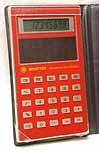
Sanyo CX-1
1980
Four-function, memory, square
root.
An early solar-cell powered, almost credit-card sized LCD calculator. Solar-cell is high-efficiency "Amorton" amorphous silicon, hence small.
Late LED and VFD display calculators
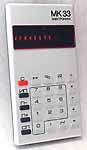
Elektronika MK-33
1980s-1990s
4 function,
%, memory, square root.
Very late example of a red LED display calculator, made in the Soviet Union.
Also details of late vacuum-fluorescent display calculators MK57A and
MK61.
The end of the 1970s signalled the end of the of the years of rapid development in calculator technology. Now you could have a credit-card sized, solar powered calculator - something unthinkable ten years earlier.
In 1979 the Hewlett-Packard HP-41C was launched, the first 'system' calculator with a variety of peripherals. 1980 also saw the appearance of the first pocket computer - something that would have been totally incredible ten years earlier.
The first hand-held 'system' calculator
Calculator development reached a pinnacle in 1979 with the launch of the Hewlett-Packard HP-41C, the first of a series of hand-held 'system' calculators with expansion ports for connecting peripherals.
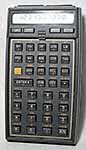
Hewlett-Packard HP-41 series
1979
Scientific programmable calculator with expansion ports.
The first hand-held 'system' calculators
.
The first pocket computer
This review of the early development of the pocket calculator ends in 1980 with the introduction of the Sharp PC-1211, the first pocket computer programmable in a high-level language. It demostrates the progress made in the 10 years from the first hand-held calculators in 1970.
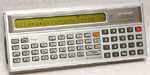
Sharp PC-1210 and Sharp PC-1211 / Radio Shack / Tandy TRS80 PC-1
1980
Calculator with Basic language, programmable.
The first pocket computers.
Only a small sample of vintage electronic hand-held calculators is shown here. There were many more models from many manufacturers, as shown in the Photograph Library.
For featured British calculators, including models from Advance, Decimo, Prinztronic, and Sinclair, see the associated British Vintage Calculators site.
For photographs of other hand-held electronic calculators see the Hand-held Calculator Photo Library.
To see more calculators from companies that only produced one or two models see the article "One Hit Wonders".
During the period 1971-1976 there was a great reduction in the size of pocket calculators, the number of electronic components inside, and most sigificantly the cost. This led to a great reduction in the number of manufacturers, and more standardisation of design.
An article in the journal New Scientist from May 1973, in the middle of this turbulent period in calculator development, brings home the situation in the pocket calculator market at
this time:
"The past 18 months has seen the list price of the cheapest pocket calculator in Britain more than halved—down, in fact, from £79 [GBP] [US£185] to £31 [GBP] [US$73]. And while the pocket calculator is
not yet a consumer durable, it is clearly destined to become as common around the office and household as, say, a portable typewriter or small transistor radio. There is almost no bottom limit to how cheap a simple electronic
calculator could cost–one sells in Hong Kong today for £7 [GBP] [US$16.50] ! The problem is how to sell such a product … At such a price, the profit margin is
likely to be much too small to interest departmental stores or even mail order firms. …
… There are still too many suppliers in the pocket calculator business—especially in the £50 [GBP] [US$115] to £80
[GBP] [US$190] range—to allow any one manufacturer to achieve a major breakthrough in sales, and hence allow prices to be brought down economically. Instead the present competition has resulted in a price war, which
eventually will lead only to fewer manufacturers being left in the market."
The major manufacturers who survived this period, for example Casio, Hewlett Packard, Sharp, Texas Instruments, produced quality calculators with extra functionality. Cheap, basic, calculators were produced in low cost countries, and were re-badged for the major companies.
For further information about the development of calculators and calculator companies go to the section "The Calculator Business" on this site.
Examples of Mechanical Hand-held Calculators
For comparison, here are examples of mechanical hand-held calculators which competed against the hand-held electronic calculators into the 1970s.
Click on a picture for more details and more bigger pictures.
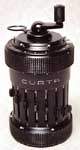
Otis King Model L
Cylindrical slide rule.
Vintage Calculators
Text & photographs copyright, except where stated otherwise, © Nigel Tout 2000-2026.