
Rivendell Cinetron
This is a new article which was not originally in "The International Calculator Collector".
The Rivendell Cinetron shows the clever adaption of a Sinclair Oxford 100 hand-held calculator mounted on a box with extra electronics to provide digital frame/time counter and calculator functions for use with sound synchronisation in cine film making.
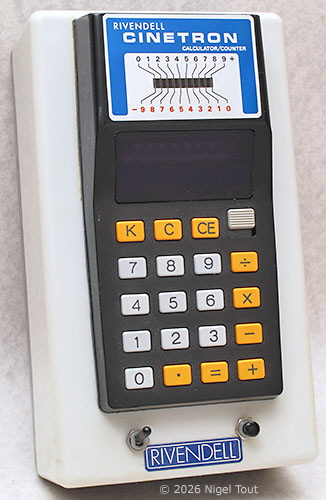
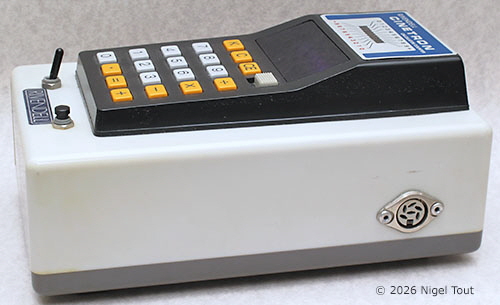
Views of the Rivendell Cinetron, showing the front of a Sinclair Oxford 100 hand-held calculator mounted on a box with extra switches, display, and DIN socket. This calculator was a low-cost model which provided the necessary functionality.
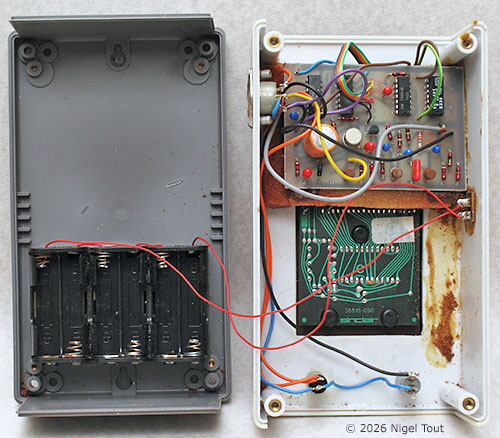
Inside the Rivendell Cinetron.
On the right is the green underside of the circuit board of the Sinclair Oxford 100 hand-held calculator mounted on the front of the box. The calculator is normally powered by a 9v type PP3 battery, but here this is replaced on the left by a battery of six 1.5V type AA cells which supply the same voltage but have much greater operating life.
At the top are two extra boards.
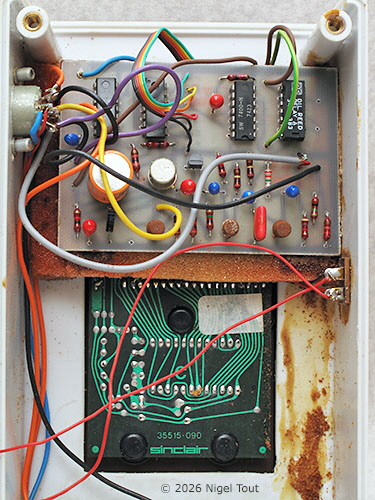
Close up of some of the extra electronics to interface the Rivendell Cinetron to cine equipment via the DIN socket.
Most of the information here about the Rivendell Cinetron was obtained using Google AI mode.
Rivendell Cineproducts (later known as Rivendell Audio Visual) was a British manufacturer well-known during the 1970s and 1980s for specialising in amateur film sound synchronisation equipment, particularly for Super 8 and 16mm film
making formats.
Before digital video and modern computer editing, adding highly precise, lip-synced audio to physical film reels required specialised external hardware . Rivendell built its reputation by creating accessible,
niche synchronisation units for independent film makers and hobbyists.
The Rivendell Cinetron was launched in late 1976. It is a specialized electronic digital frame/time counter and calculator manufactured in the UK during the 1970s and 1980s by Rivendell Cineproducts. It was designed primarily for amateur and independent filmmakers using Super 8 and 16mm film format synchronization.
The technical genius—and primary quirk—of the Rivendell Cinetron is that it does not utilize a standard industrial micro-controller or custom gate array. Instead, it was an early example of an unauthorized commercial hardware modification (a hardware "hack") built on consumer calculator parts.
Its key features are:
• Pulse Synchronization: It works alongside tape recorders and projectors to accurately measure film frames and track sync pulses, solving the common problem of matching audio to film.
• Dual
Functionality: It operates both as a live frame counter for film editing and as a dedicated electronic calculator for calculating projection times, shooting ratios, and frame-to-time conversions.
• LED Display: Features a
bright digital readout (using the red LED technology typical of 1970s electronics) to ensure frame accuracy during darkroom or editing desk work.
The Rivendell Cinetron is essentially an early Sinclair Oxford 100 calculator arithmetic main board that has been intercepted by a custom auxiliary board. The Rivendell Modifications: The custom layout logic intercepts the keypad matrix. When external pulses from an 8mm/16mm projector or a sync-pulse tape recorder hit the Cinetron's input jack, the Rivendell auxiliary board synthesises these pulses into standard "button presses" (specifically, simulating rapid + 1 commands) at a hardwired mathematical constant representing the frame rate (e.g., 18 or 24 fps). The input interface is via a DIN multi-pin socket for remote optoelectronic sprocket sensors or tape sync pulse signals.
The Counting Hack (The Keyboard Matrix): Rather than standard digital binary counters, the Cinetron tracks film by physically simulating rapid key presses on the Sinclair chip matrix.
• To count frames, the Cinetron's logic was programmed identically to a manual user entering 1 + 1 = = = = into a pocket calculator to increment numbers.
• Instead of a human pressing the = key, the Cinetron utilized a built-in reed relay or a fast optocoupler transistor switch wired directly across the keyboard contacts of the calculation chip.
• Optoelectronic Interfacing: The machine featured an input port for an external sensor head (a miniature optoelectronic light-interrupter block). This block clamped onto an editing bench or a film projector. Every time a physical film sprocket hole passed through the sensor, a light beam was broken, sending an electrical pulse that triggered the internal "equal sign" relay to increment the display by exactly 1.
It provides up to 8 digits of display capability, allowing a filmmaker to track massive frame sequences (e.g., up to 999,999 frames).
The Sinclair Oxford 100 calculator is featured on the sister Vintage British Calculators site at http://www.vintagebritishcalculators.info/html/oxford_100-gillette_gpa.html.
Calculator Articles
Vintage Calculators
Text & photographs copyright, except where stated otherwise, © Nigel Tout 2000-2026.