Sharp EL-805
and other early Sharp LCD calculators
Sharp calculators with Dynamic Scattering Mode (DSM) Liquid Crystal Displays
Sharp was one of the pioneers of calculators using the DSM (Dynamic Scattering Mode) LCD (Liquid Crystal Display). These DSM LCDs have the now unusual feature of silver-like reflective digits on a dark background, rather than the now common black digits on a light background.
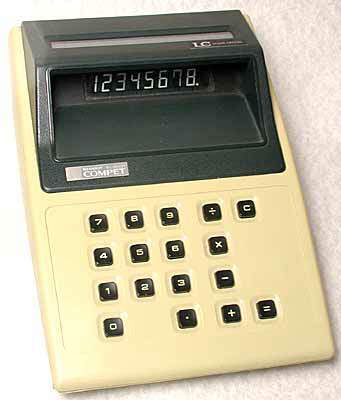
Although Sharp was one of the pioneers of LCD displays, Rockwell is usually credited with producing the first commercial LCD calculators the previous year, 1972, though these required an internal light source and were much larger; see the Lloyds Accumatic 100. However, Rockwell quit LCD calculators after a few models whereas Sharp persisted with the development of LCD displays and later produced many models with the now familiar LCD with black digits.
Some of these DSM LCD calculators also employ Sharp's 'COS' (Crystal on Substrate) technology. This is a method of manufacture used in the early Sharp LCD calculators where the LCD is formed directly on a glass circuit board substrate (see the close-up photographs below) on which the other electronic components are also mounted. Some subsequent Sharp models with the reflective DSM LCD, although not having the LCD directly formed on the circuit board, are also commonly referred to, incorrectly, as 'COS' models.
The following details of the development of COS and the Sharp EL-805 are based on information kindly supplied by Sharp Corporation:
"A development team headed by Isamu Washozuka had been engaged in developing LCD
devices for calculators. Although Rockwell had already produced some large, desktop, AC-powered LCD calculators, the Sharp team succeeded in integrating CMOS-LSI ICs and LCD devices onto a single glass substrate. This was
termed COS or Crystal On Substrate.
Using this technology, the Sharp Compet EL-805 calculator was launched as the world first battery-powered LCD pocket calculator. This was a breakthrough in the sense that the MOS-LSI and
LCD technologies established by this calculator was the starting point for the development of the low-power mobile appliances and personal computers of today."
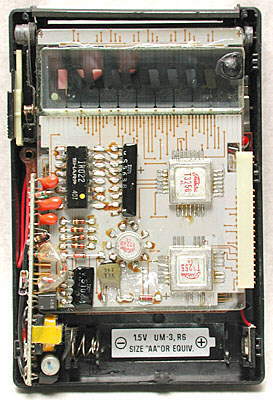
The true COS (Crystal on Substrate or Calculator on Substrate) calculator has a circuit board which is made of a glass-like ceramic — see the close-up photographs below. The LCD display is formed directly on this circuit board, which also carries at least two layers of conductive tracks separated by a white, insulating lacquer, and the electronic components. The glass circuit board has no holes in it, all of the components being surface-mount types. The user actually looks through the circuit board when viewing the display.
This use of the glass circuit board appears to have been a dead-end in the development of calculators, perhaps because of cost. Subsequent models from Sharp with this type of display have conventional circuit boards, though their LCD display modules have a similar construction to the display section on the glass circuit boards.
All the Sharp models with displays with reflective LCD characters are often referred to as COS models, though this should really only refer to the early examples with the glass circuit boards.
One characteristic of these early DSM (Dynamic Scattering Mode) LCDs with their reflective digits is that they have a hood over the display with a clear window. This allows ambient light coming at the best angle to be reflected of the digits to give optimal viewing of the display. These hoods over the display often take the form of a flip-up display cover which also protects the display when the calculators is not in use.
The DSM LCD calculators featured on this page are:
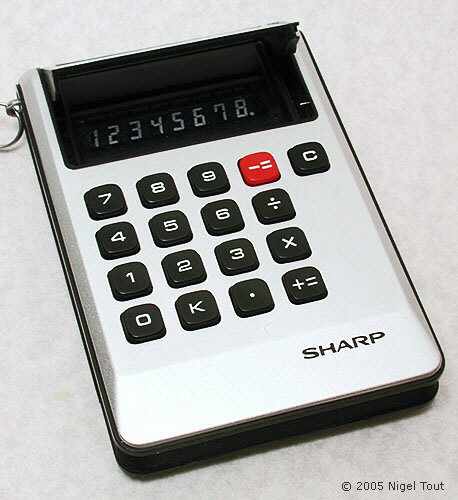
The Sharp EL-805, with the display cover open, in operation.
Sharp EL-805
Distinctive features: The first pocket-sized calculator with liquid crystal display (LCD), using DSM (Dynamic Scattering Mode) LCD with reflective digits. Also uses Sharp's COS (Crystal on Substrate) technology.
Technical details:
Display is 8 digits, reflective LCD.
4-function.
1.5v (1x AA cell).
80 mm x 120 mm x 21 mm (3.1" x 4.75" x 0.8").
1973. Cost in U.S.A. in December 1973 was US$109.95[1].
Made in Japan.
In December 1973 the journal 'Electronics' reported[2]:
" While last year the preoccupation in Japan was how low the price could go, with Casio,
Busicom, and later even Sharp leading the downward trail, this year, this year there has been more serious concern with quality machines. Even though low-priced units have been profitable in Japan, manufacturers began to
sense that many consumers would want to upgrade.
For this reason, Sharp's announcement of the Calculator on Substrate EL-805 was greeted with immediate orders from dealers. Using a highly automated
assembly and test line, Sharp has got production up to 300,000 units a month now."
The Sharp EL-805 of 1973 was the first pocket-sized calculator with a Liquid Crystal display (LCD) and used Sharp's 'COS' (variously 'Crystal on Substrate' or 'Calculator on Substrate') technology, as illustrated in the photographs below.
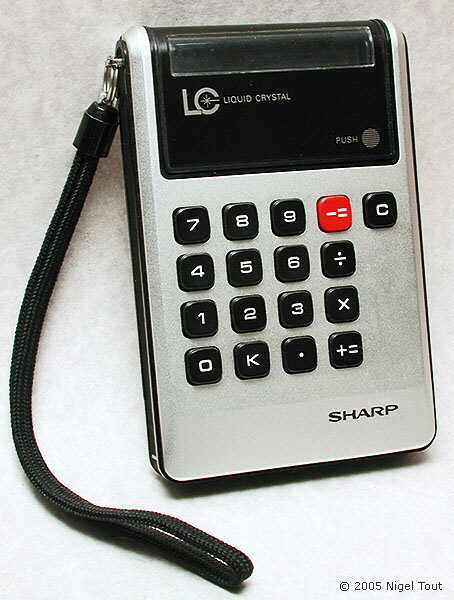
The Sharp EL-805 with the display cover closed.
Pressing on the lower edge of the cover releases it and also turns on the calculator.
The cover provides physical protection to the LCD, and was perhaps also useful in preventing UV light from possibly damaging the liquid crystal if the calculator was left in sunlight.
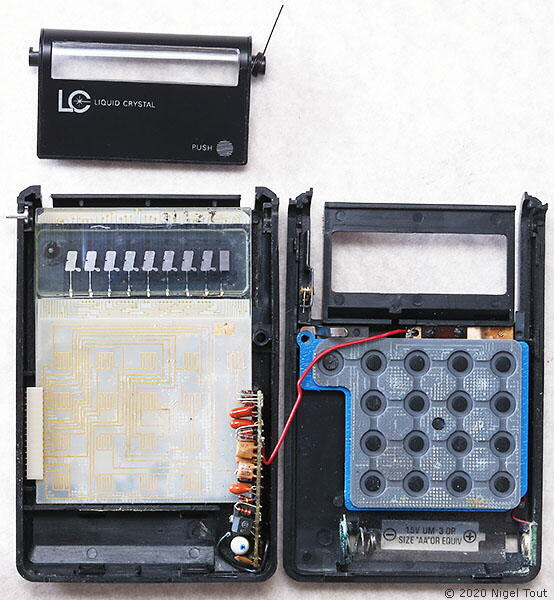
Here the keyboard, on the right, and the display cover, at the top, have been removed to show the COS circuit board with the DSM LCD. This is the direction from which the LCD is viewed when the calculator is in use.
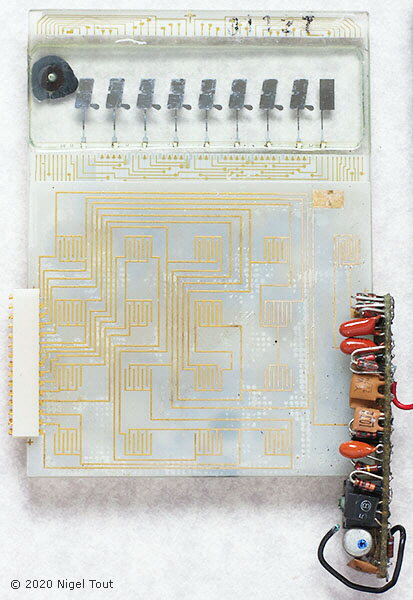
The glass-like ceramic COS circuit board has been completely removed from the housing, and shows the DSM LCD digits at the top.
This side of the board has the square conductor matrices of the key contacts.
Low down on the left is a connector linking the copper traces on both sides of the board since there is no through-hole plating here.
Low down on the left is a small circuit board holding conventional wired (i.e. non-surface mount) components. This daughter circuit board has a connector which connects to conductors on both sides of the main COS circuit board.
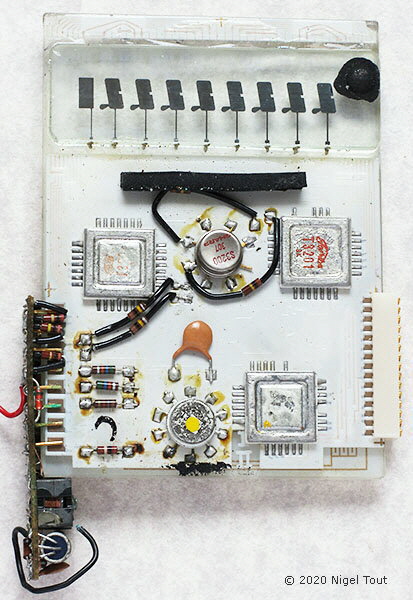
Here the COS circuit board has been turned over, viewing the rear of the DSM LCD digits at the top.
Five surface-mount integrated circuits, three square and two round, can be seen. Also conventional wire-ended resistors and a ceramic capacitor are also soldered to the surface of the conductors which can just be made out under a white coating.
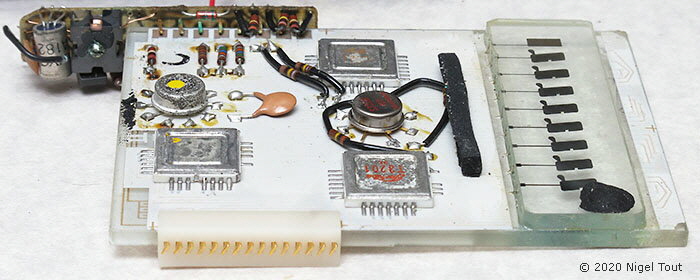
From the side the considerable thickness, almost 3mm, of the ceramic COS circuit board can be seen, with double that thickness at the display.
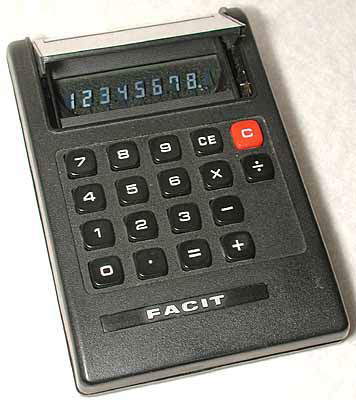
Facit 1106 / Sharp EL-805S
Technical details:
Display is 8 digits, liquid crystal display (LCD), using DSM (Dynamic Scattering Mode) LCD with reflective digits. Also uses Sharp's COS (Crystal on Substrate) technology.
Technical details:
4-function.
Integrated circuits - Toshiba T3255, T3256, T3288 (here date coded 1974).
1.5v (1x AA cell).
80 mm x 120 mm x 21 mm (3.1" x 4.75" x 0.8").
1973.
Made in Japan.
This Facit 1106 is similar to the Sharp EL-805S, except the casing is black plastic whereas the front of the Sharp EL-805S is brushed metal. The Sharp EL-805 of 1973 was the first calculator with a COS (Crystal on Substrate) LCD (Liquid Crystal Display). A few months later in 1973 the Sharp EL-805S was introduced, with improvements such as a brighter display.
In the late 1960s and early 1970s Sharp produced calculators for the Swedish Facit company. Most are similar to Sharp models but with differently styled casings. This model is based on the Sharp EL-805S.
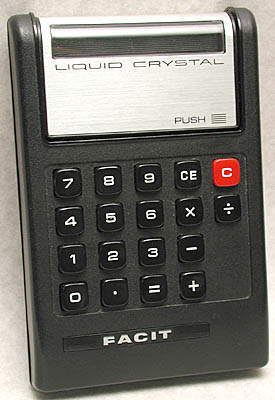
With the display cover closed.
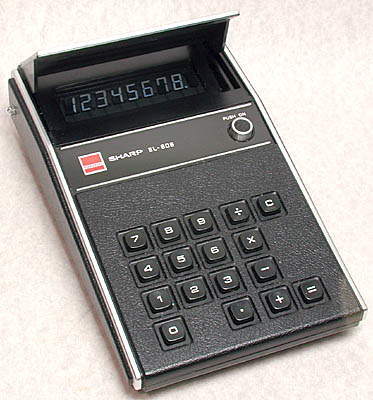
Sharp EL-808
Technical details:
Display is 8 digits, reflective liquid crystal display (LCD), using DSM (Dynamic Scattering Mode) LCD with reflective digits. Has flip-up display cover.
Technical details:
4-function.
Main integrated circuits - NEC uPD224C & Sharp IR022 (here date coded 1973).
6v (4x AA).
107 mm x 176 mm x 40 mm (4.25" x 6.9" x 1.6").
About 1973.
Made in Japan.
Sharp EL-8001
Technical details:
Display is 8 digits, reflective liquid crystal display (LCD), using DSM (Dynamic Scattering Mode) LCD with reflective digits.
4-function.
Main integrated circuit - NEC uPD224C (here date coded 1973).
6v (4x C).
144 mm x 212 mm x 70 mm (5.7" x 8.5" x 2.75").
About 1973.
Made in Japan.
Not a 'COS' calcualtor, but using the same reflective DSM (Dynamic Scattering Mode) LCD display as the COS models. This is a large calculator designed as a portable desktop model and is too big to fit in a pocket. Surprisingly for a model with LCD display, which has a low power consumption, it is powered by 4 large size C cells. Perhaps it was intended to be left powered up all day.
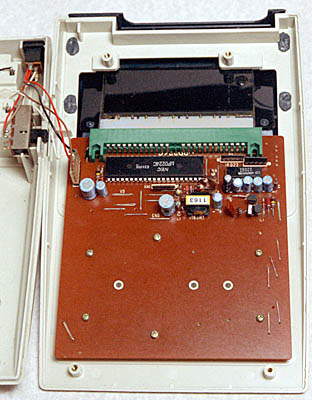
The Sharp EL-8001 with the back cover removed. This shows the conventional phenolic composite circuit board with the integrated circuit mounted towards the top, and the display, seen from the back, as a module which plugs into the green socket.
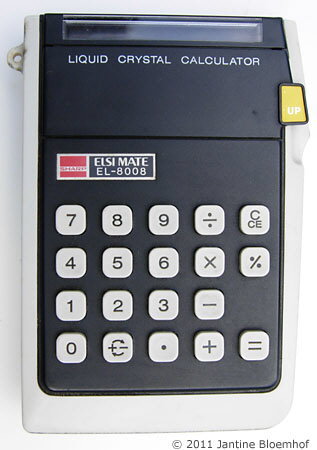
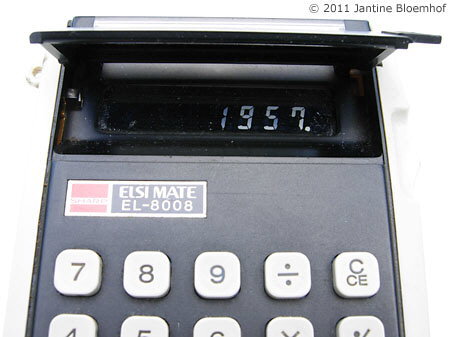
With the display cover flipped up.
Sharp EL-8008
Technical details:
Display is 8 digits, reflective liquid crystal display (LCD), using DSM (Dynamic Scattering Mode) LCD with reflective digits. Has flip-up display cover.
4-function, %.
1x AA battery.
83x127 mm / 3.25x5.0".
Made in Japan.
Photographs kindly supplied by Jantine Bloemhof.
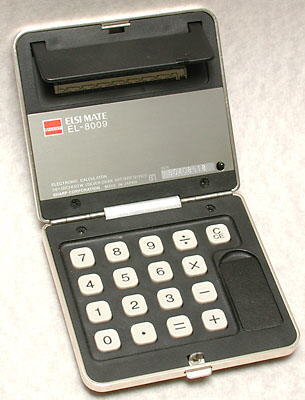
Sharp EL-8009
Technical details:
Display is 8 digits, reflective liquid crystal display (LCD), using DSM (Dynamic Scattering Mode) LCD with reflective digits. Has flip-up cover.
4-function.
2x silver oxide button cells.
Folding "clam-shell" style:
Closed 79 x 144 x 11 mm / 3.1 x 5.7 x 0.4".
Open 79 x 73 x 19 mm / 3.1 x 2.9 x 0.75"
Introduced in 1975.
Made in Japan.
Cost - about US$45.
Available in 4 different finishes, 2 metallic and 2 leather-type.
The clam-shell design allows full protection for the keyboard and display while giving a very small size. The calculator is automatically switched on when opened and off when closed.
A brochure for Sharp calculators states for this model "4 different elegant finishes available: metallic gold or silver, or fine leather in brown or red".
The journal 'Electronics', for April 3, 1975, reported the introduction of the Sharp EL-8009 and the Sharp EL-8010[3]:
"Sharp's calculator-in-a-compact [EL-8009] for women and pocket-diary unit [EL-8010] go on the market this month in Japan, Europe, and the United States. ...
Power conscious. Sharp's calculator-in-a-compact features new technology in the form of a single flexible printed-circuit board that includes all components, wiring, keyboard
contacts, and display-connector contacts. Both Sharp machines are made possible by the low power drain of liquid-crystal displays and complementary-metal-oxide-semiconductor circuits.
The
calculator-in-a-compact is an eight-digit, four-function unit with clear-entry and clear-all capability. It will sell for about $45 in the U.S. The pocket-diary unit, which also includes percent and sign-change keys, is
ticketed at about $35.
The "compact" is very small, only 19 by 79 by 71 millimeters when folded or 9.5 by 79 by 142 mm when opened. Weight, including power cells, ranges from 115 to 127 grams depending
on case material. Two Mallory MS 76 silver-oxide cells provide 25 hours of operation. Power drain is a low 0.02 watt, about 1/20 that of Sharp calculators using green fluorescent displays. The polyimide flexible
substrate is the same type of plastic often used in computer harnesses and connectors. The substrate is bent double when the calculator is closed, but it has successfully passed tests during which it was flexed approximately
100,000 times."
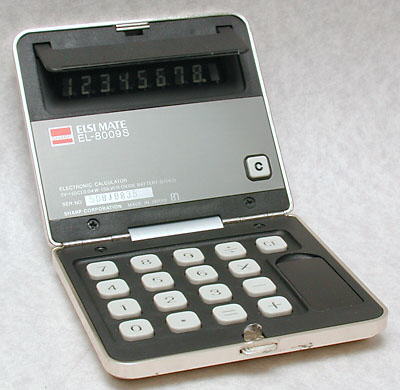
Sharp EL-8009S
Technical details:
Display is 8 digits, reflective liquid crystal display (LCD), using DSM (Dynamic Scattering Mode) LCD with reflective digits. Has flip-up cover.
4-function.
2x silver oxide button cells.
Folding "clam-shell" style:
Closed 79 x 144 x 11 mm / 3.1 x 5.7 x 0.4".
Open 79 x 73 x 19 mm / 3.1 x 2.9 x 0.75"
Made in Japan.
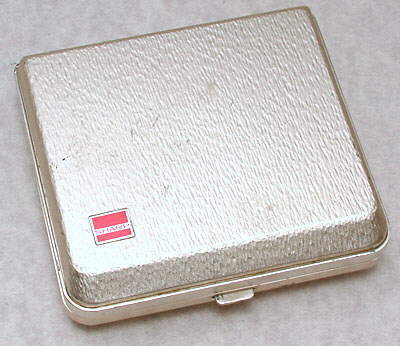
The Sharp EL-8009S closed. It has a light-gold coloured metallic finish.
Sharp EL-8010
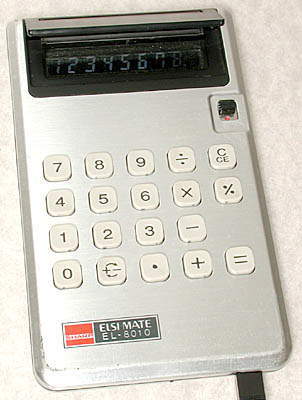
Technical details:
Display is 8 digits, reflective liquid crystal display (LCD), using DSM (Dynamic Scattering Mode) LCD with reflective digits. Has flip-up cover.
4-function.
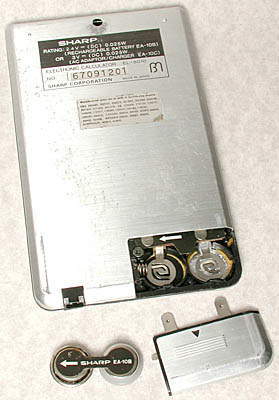
2x rechargeable Ni-cad button cells in an assembly, EA-10B. Or, with battery adapter, 2x Silver oxide, or 2x Mercury cells.
76 x 129 x 10 mm (3.0" x 5.1" x 0.4").
Introduced in 1975.
Made in Japan.
Cost - about US$35.
The journal 'Electronics', for April 3, 1975, reported the introduction of the Sharp EL-8009 and the Sharp EL-8010, which it refers to as a 'pocket diary' since it
fits into a folding soft case like many pocket diaries[2]:
"The calculator in the pocket diary is only 9
mm thick by 76 by 129 mm. Its pc board is thinner than usual, but of normal pc-board material. Two nickel-cadmium cells will operate the calculator with its 0.025w power drain for about eight hours. Alternatively,
two Mallory RM 625 mercury cells will operate the calculator for about 35 hours."
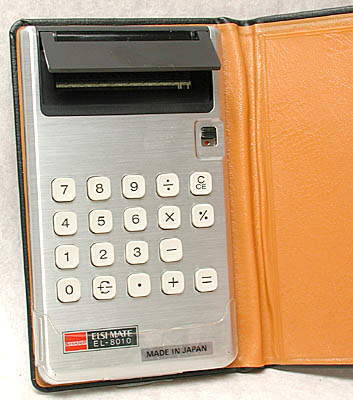
The small size of this calculator, especially the small thickness, allowed it to be one of the first that was provided with a folding case, into which it clips, for protection in the pocket coupled with ease of use.
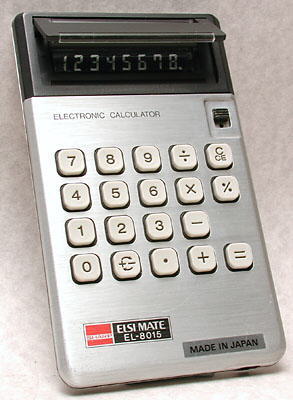
Sharp EL-8015
Technical details:
Display is 8 digits, reflective liquid crystal display (LCD), using DSM (Dynamic Scattering Mode) LCD with reflective digits. Has flip-up cover.
4-function, %.
2x rechargeable Ni-cad button cells in an assembly, EA-10B. Or, with battery adapter, 2x Silver oxide, or 2x Mercury cells.
76 x 129 x 10 mm (3.0" x 5.1" x 0.4").
Made in Japan.
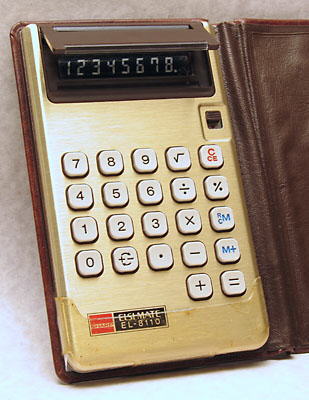
Sharp EL-8110
Technical details:
Display is 8 digits, reflective liquid crystal display (LCD), using DSM (Dynamic Scattering Mode) LCD with reflective digits. Has flip-up cover.
4 function, %, memory, square root.
2x rechargeable Ni-cad button cells in an assembly, EA-10B. Or, with battery adapter, 2x Silver oxide, or 2x Mercury cells.
76 x 129 x 10 mm (3.0" x 5.1" x 0.4").
Made in Japan.
Has gold-coloured metallic casing.
See the article "Liquid Crystal Display (LCD) Calculators" on this site for information about other early LCD calculators.
For further information about Sharp Corporation and its calculators visit the Calculator Companies section of this site.
Excellent Youtube videos produced by Michiel de Boer that graphically explain these Liquid Crystal Displays are:
- "The DSM LCD (like) you've never seen" - https://www.youtube.com/watch?v=eGQQWIbD-nM
- "LCD Explained (and more)" - https://www.youtube.com/watch?v=J6W1jYoa1HM
References:
Hand-held Calculators
Vintage Calculators
Text & photographs copyright, except where stated otherwise, © Nigel Tout 2000-2026.